
Young's Inequality & Its Consequences
Cambridge STEP 1 | 1987 | Question 6
Hello my dear friends of Math Games, welcome back to the 6th question of 1987’s Cambridge STEP Exam. As a reminder, these questions were designed to test out the most mathematically capable students hoping to read mathematics at the University of Cambridge.
If you enjoy what I do here on Medium and Substack, consider becoming a paid member, it’s the best way to keep the Math Games Empire growing.
What good is a math problem if not to be solved with grit and wit? What follows is a complete solution, but a complete solution, read cold, teaches rather less than a partial attempt, wrestled with honestly.
Ergo, set aside a few minutes. Work through the steps. Let the difficulty be felt. The argument will mean considerably more once you have traced some part of it yourself.
Solution
Here we let

where g is the inverse function of f, so that

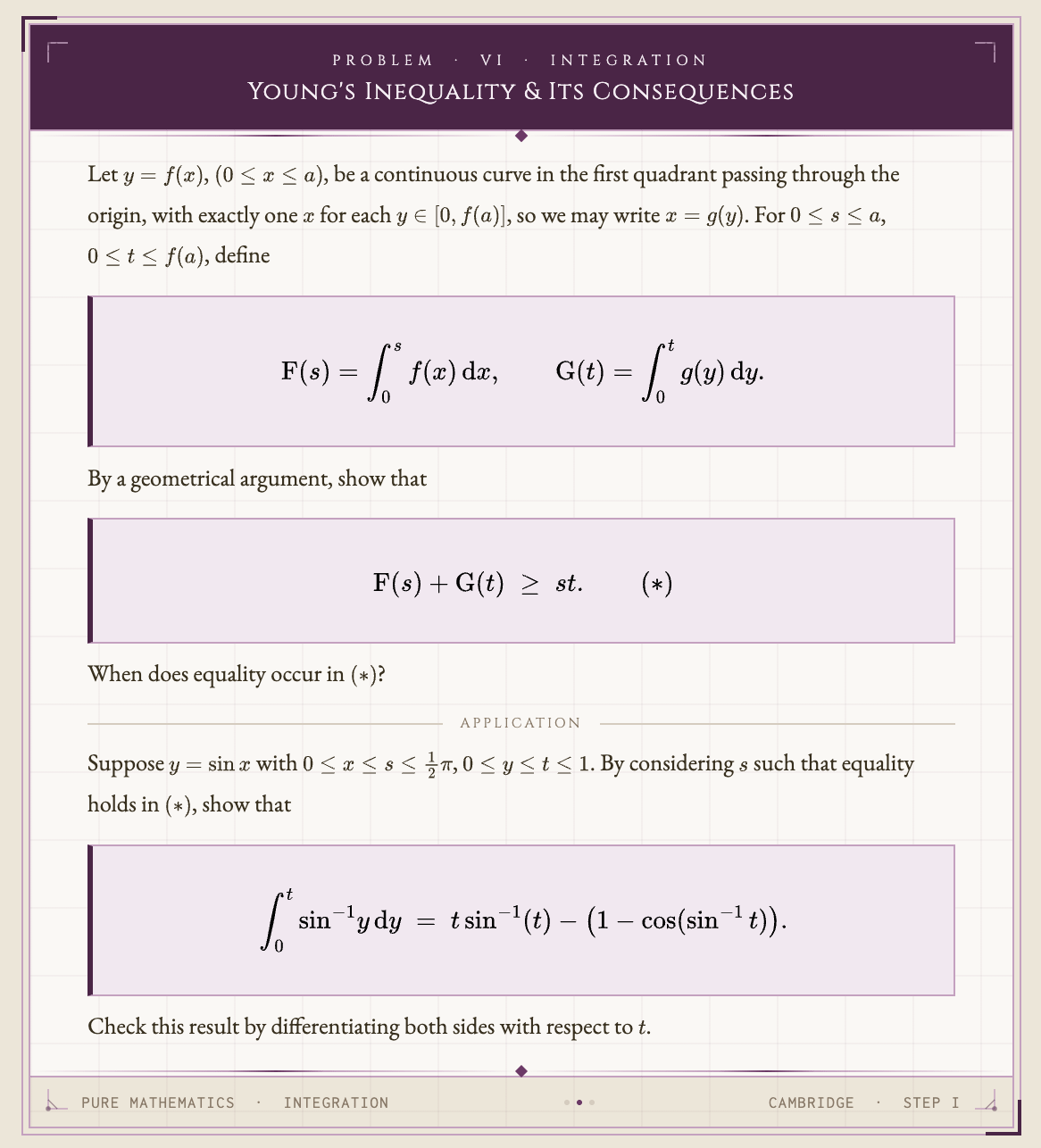
We are required to show that
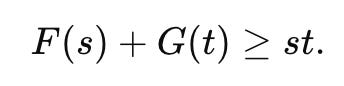
Let’s interpret the integrals geometrically.
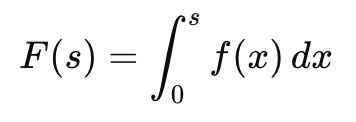
This integral F(s) represents the area under the curve y = f(x) from x = 0 to x = s.
Similarly,
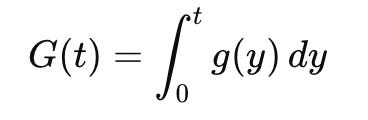
The integral G(t) represents the area to the left of the curve x = g(y) from y = 0 to y = t.
Now let’s think about the rectangle with vertices

Its area is
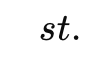
The two regions represented by F(s) and G(t) together cover the whole rectangle, so their total area is at least the area of the rectangle.
Hence,
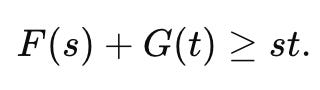
When does equality occur?
